

Between darkness and light
shines a clear, luminous blue

Hello friends
I have to acknowledge the darkness and weight of this moment, the unspeakable suffering in Gaza and Darfur and Ukraine, the sinister power and dark intentions of the tech oligarchs, the growing fragility of democracy, the erosion of press freedom, the dwindling of the natural world, as late stage Capitalism, in the name of shareholder profit, seems intent on devouring everything, everything, everything left that we love.
You carry this weight too, I know, and most likely a far heavier share of it than I do.
We can’t ignore it, nor should we. But sometimes, those of us who are able to, also need to set that weight down for a time, and look up, and remember the beauty that’s still here.
At the weekend I went for a walk with a dear friend. After a busy few months for both of us, we needed to reconnect, with each other and with this…
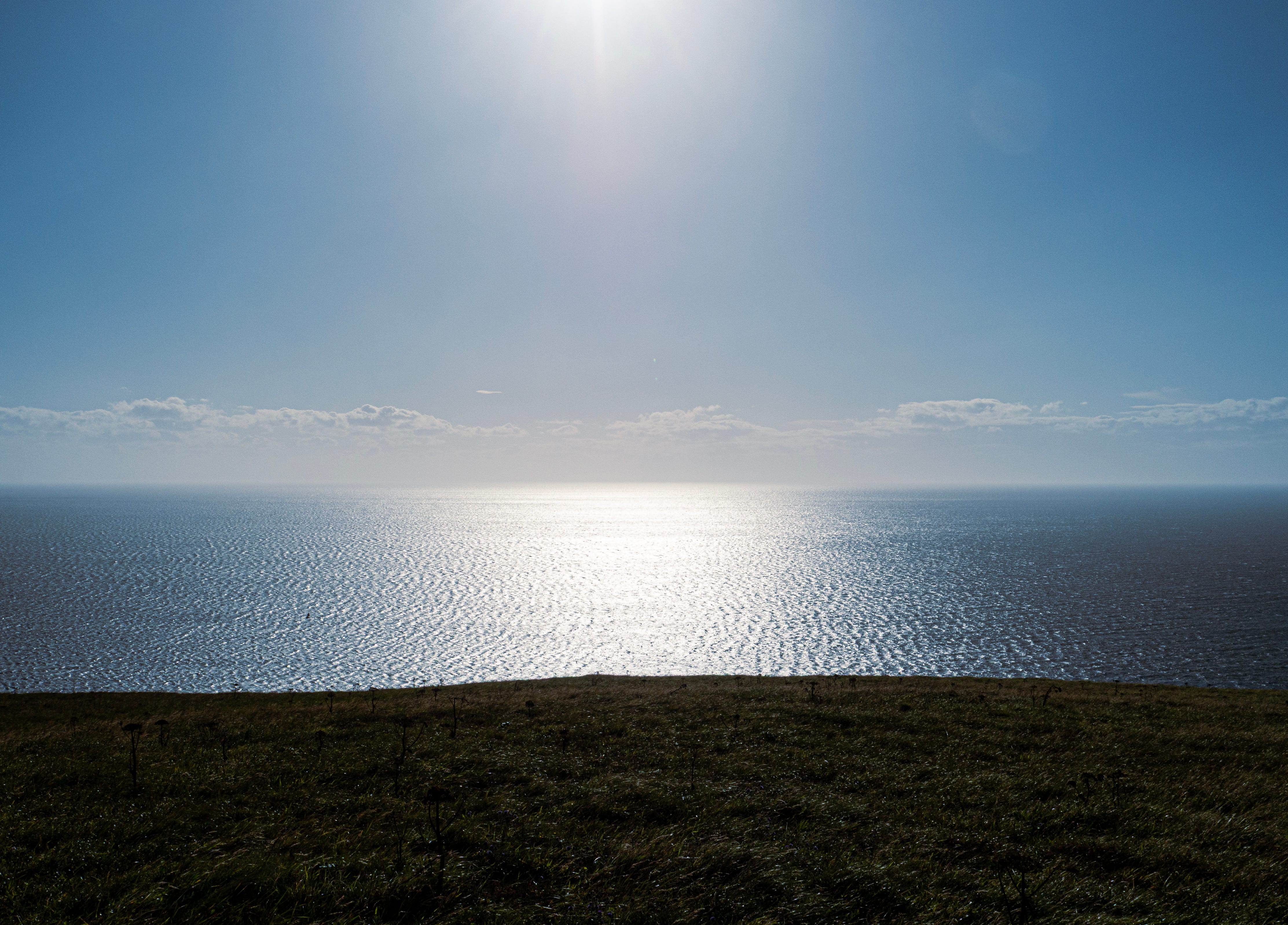
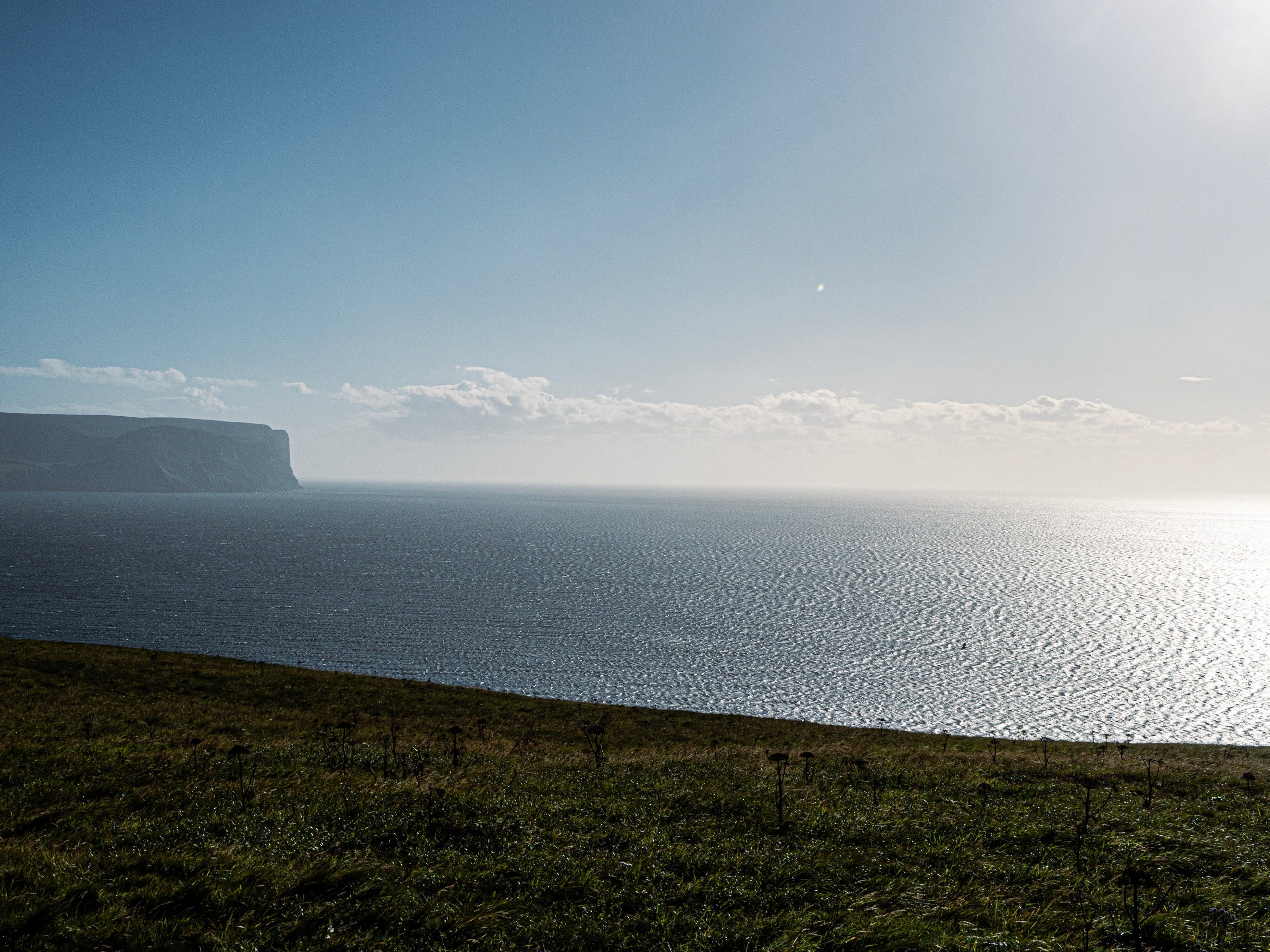
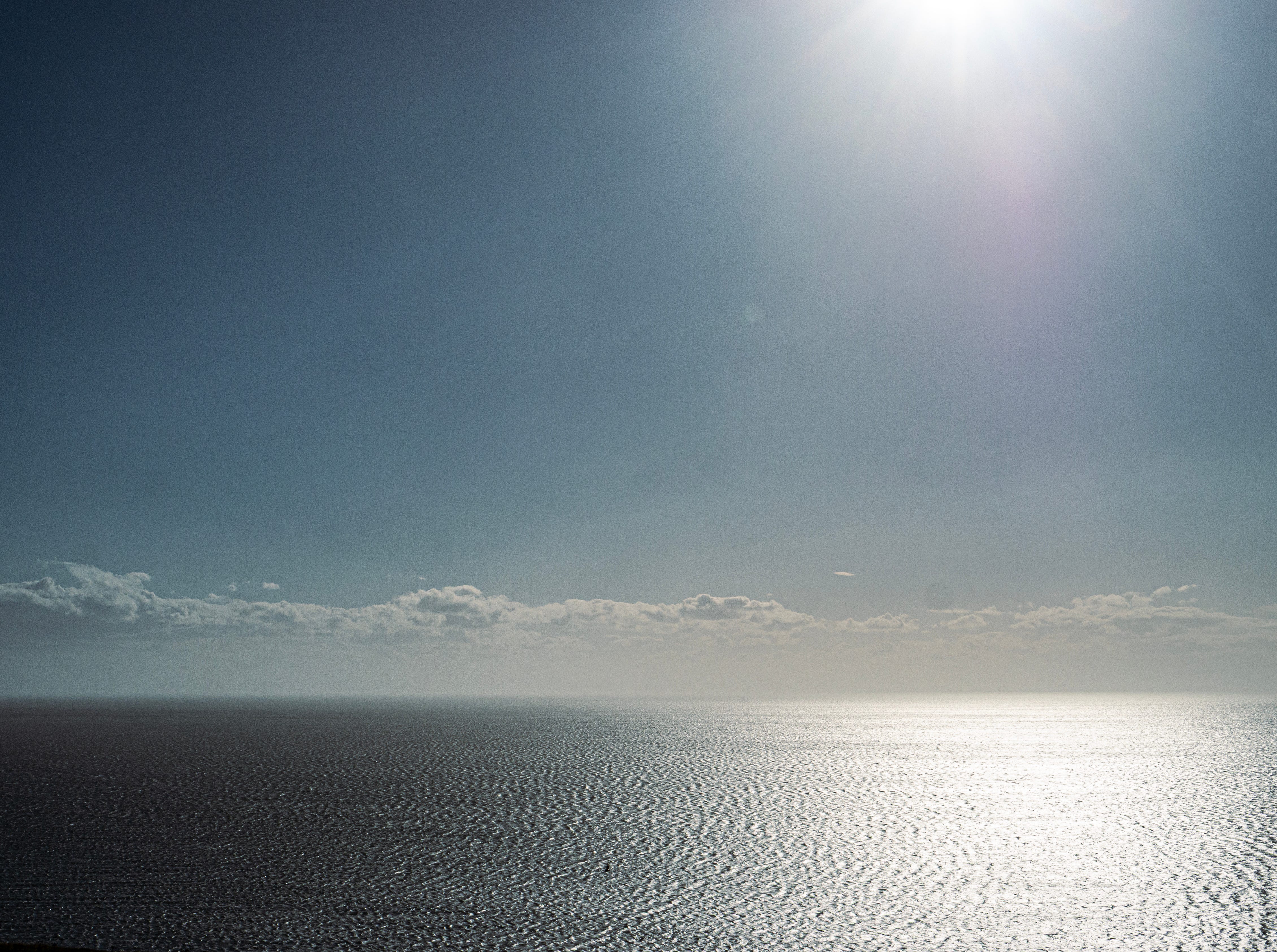
It was windy, sunny afternoon as we followed the narrow path worn into the tussocky grass and heather, up the hill above Billia Croo. When we reached the rounded summit we stopped to catch our breath. A wide, shimmering expanse spread out before us. The shining blues of sky and sea, one luminous, one glittering, blurred softly into each other at the horizon in a haze of salt and cloud.
Blue is everywhere in the air and water around us, but blue objects are rare in nature. In the development of languages, a word for the hue we call ‘blue’ comes late, if at all, after ‘black’. ‘white’, ‘red’ and ‘green’ and ’yellow’. An undifferentiated field of blue that can’t be touched or manipulated doesn’t need to be named.
As James Fox writes in The World According to Colour: A Cultural History:
“Absent from the world: it is a good way to think about blue. Unlike most other hues, blue thrives only in the unearthly realm of sky, sea and horizon. But even those fields of colour are an apparition.
Cloudless skies are blue because of a process called Rayleigh scattering: when sunlight travels through earth’s atmosphere, shortwave blue photons are disrupted by molecules in the air, torn away from their counterparts and scattered in all directions across the firmament. The sea is blue because it mirrors the sky, and because water tends to reflect short wavelengths of light, converting others to heat.
Horizons are often blue because of a phenomenon related to Rayleigh scattering called aerial perspective; as objects recede from us, they are veiled by ever more scattered light, appearing progressively bluer, before terminating in a hazy cerulean horizon. All these blues reside not in surfaces but in depths, not in objects but in the spaces between them.”
I could feel the blue air moving briskly around me, needling through the weave of my clothing, tugging my hair, rubbing pink into my cheeks, salting my lips, running through my open hands with a weight like water.
But if I held out my hands to cup some of that fast-flowing air between my palms I would not find myself holding a fragment of the blue sky. If I caught a glassful of that seawater and examined it up close its blueness would vanish. The blue is in the space.
Blue slips through our fingers. Like the horizon, it retreats as we approach. ‘Blue’. Say it aloud. Feel how the word itself bursts out of the mouth, follows the breath outwards and is gone.
My friend and I spread our arms and leaned into the wind, a barrelling, boistering, brawling wind that kept us wary of getting too close to the cliff edge below us. Both of us laughed. We felt brightly alive in a lively world of light and water and air, this shining blue world of ours.
It’s hard to believe now, but the realisation that our planet is distinctly and gleamingly blue is a very recent one that was first revealed to early astronauts. Yuri Gagarin reported from aboard Vostok 1 with some surprise that “the Earth has a very characteristic and very beautiful blue halo.”
But the rest of us didn’t get to see this blue until 1968, when NASA sent a three man crew on Apollo 8 to study the moon’s surface for future landing sites. When they emerged from the ‘dark’ side of the moon on their final orbit they saw something slide into view of their capsule’s small window that changed them forever, a sight that astronaut Frank Borman said was:
“The most beautiful, heart-catching sight of my life, one that sent a torrent of nostalgia, of sheer homesickness surging through me. It was the only thing in space that had any colour to it. Everything was either black or white, but not the Earth”
The Earth was blue. A beautiful, bright, marbled blue.
When they brought the pictures back, we were all finally able to see that we live on a small blue planet.
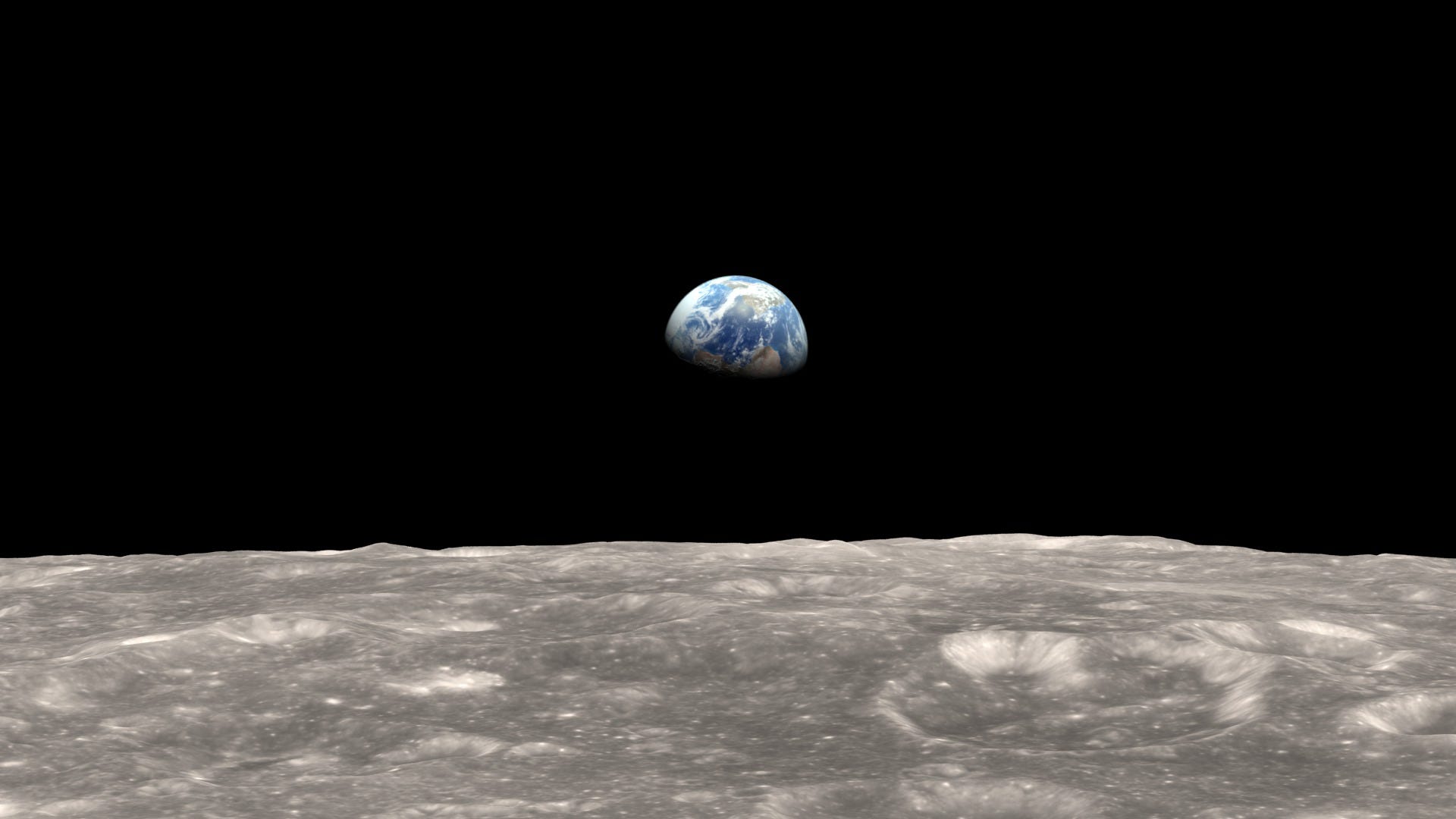
Borman’s crewmate, Bill Anders, took the now famous photograph of “Earthrise”. Years later he reflected:
“…when I looked up and saw the Earth coming up on this very stark, beat up lunar horizon, an earth that was the only colour we could see, a very fragile looking Earth, a very delicate looking Earth, I was immediately almost overcome by the thought that we came all this way to see the moon, and yet the most significant thing we’re seeing is our own home planet, the Earth.”
As James Fox writes
“For most of history, blue was the quintessential colour of other worlds, distant mountains, unfathomable oceans, unreachable skies, the uncharted territory of the soul. But when we finally escaped our world and voyaged beyond its horizons, we discovered that all along blue was the colour of home”.
But we couldn’t see the blue of Earth until we left it.
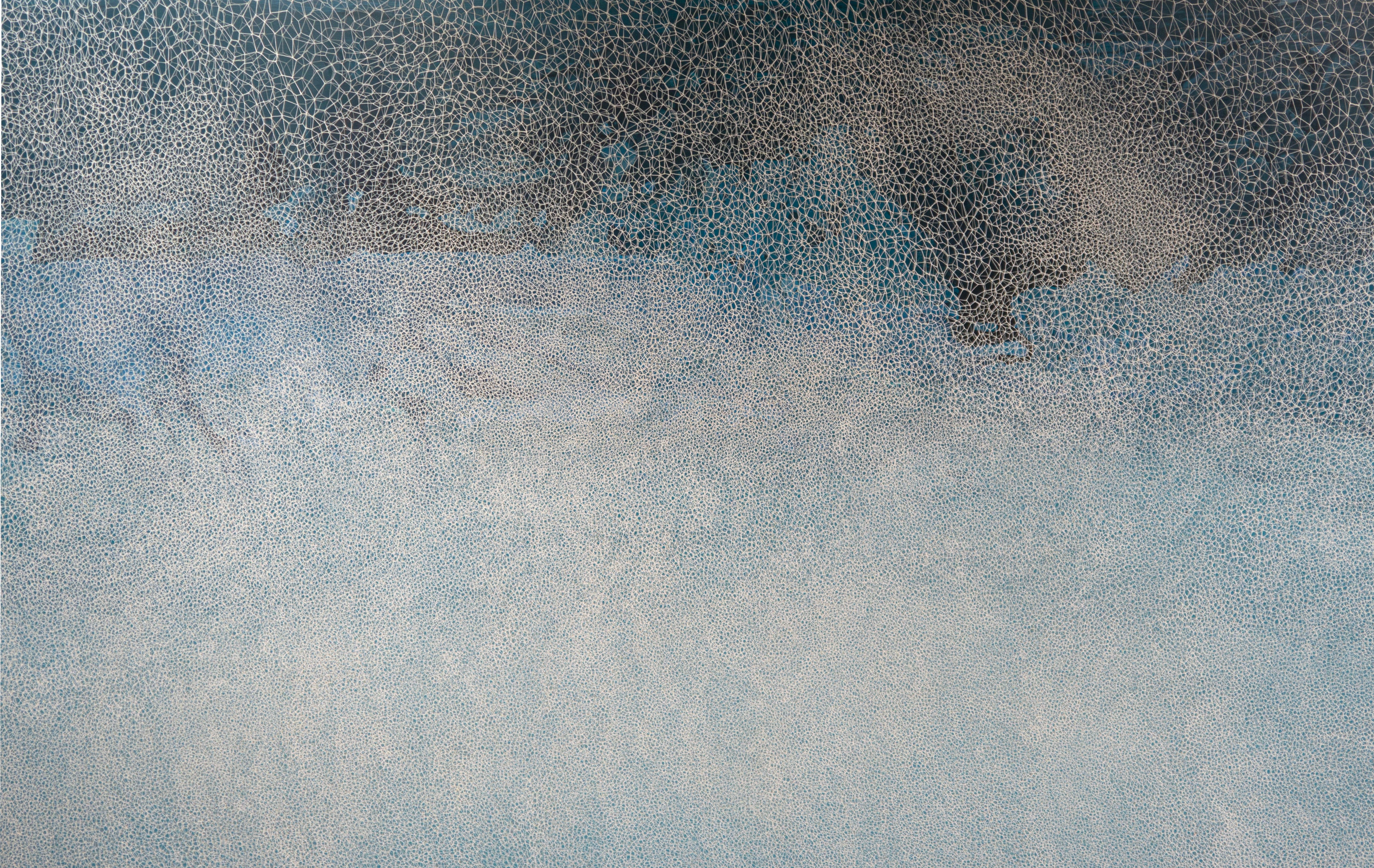
As mentioned in last week’s post, the ancient Greeks famously had no word for blue, in spite of living immersed in the luminous blues of the Aegean sea and sky. They saw colour as relational and dynamic, a living quality of a living, sacred world
As Dr Sasha Chaitow explains:
“To the ancient Greeks, colour was never fixed to a chart. Their word for it — χρώς (chrōs) — meant skin, surface, or flesh, in contrast to bone. It could mean colour in the sense of something that covers like a skin, but its conceptual range extended far beyond hue. For the Greeks, colour was understood in terms of its nature, its behaviour, and its origin: how it shone, shifted, or emanated, and where it came from.”
Instead of thinking of colours as Newton taught us, as seven neat slices of a closed spectrum, we might think of colours as qualities, like the ancient Greeks.
Blue would have the quality of space and unsettledness, somewhere between luminosity and darkness, distance and proximity, home and homesickness, joy and sorrow.
In complete darkness we are blind. The Sun’s unfiltered light would blind us too. Our blue planet tilts between the two, holding both darkness and light in an ever-shifting balance. And we must do the same.
The Life Raft Co-Creating Community
Climb aboard with me! You are warmly welcomed to join our weekly creative co-working session on Zoom. Our meetings are a little Life Raft of shared creativity in these stormy times. It’s very simple. We just say hello at the start and say what we plan to work on and then leave our cameras on and work together in companionable silence. We start at 3pm UK time and finish around 4.30pm. Just click the link below to join us. If you can’t make it live I share a recording to the paid subscriber chat each week.

That’s all for this week!
Sam
Your words feel so resonant and powerful for me this morning. The land around our village is being steadily ploughed and ripped up by a family who own and are buying more of the farms in the area. They farm strawberries, and fill the vast acres they now own with tunnels and blank soil, populated by hundreds of rows of plants, fertilized with chemicals. They have installed sonic cannons, to keep away the birds, everywhere, and we hear what sounds like gunshots several times a minute all through the day. My heart breaks to see the bare ground, once filled with communities of clover, vetch, grasses and little animals - bees, buck, small wild cats. In spite of this, I agree with you that beauty is a stubborn and persistent presence, and sometimes the most important creative work we can do is to reflect that. My small garden is full of birds, many new ones that are perhaps fleeing the destruction of their homes. And that is a blessing.
A poignant and profound piece today Samantha. Just when I’m feeling the dark weight of all the hideous things we can do to each other pressing down on me you’ve illuminated the darkness with a fine blue light. Thank you.